Assembly of didactic structures with movement for teaching physics carried out at Tecsup Arequipa headquarters during 2024
DOI:
https://doi.org/10.71701/xvbm8j04Keywords:
Structure, Physics, Innovative, Strength, AssembleAbstract
The study focuses on analyzing the construction of structures, with beams of different sizes, as well as the use of connectors at different angles, which together form some type of structure similar to some built reality in our environment or within our reach.
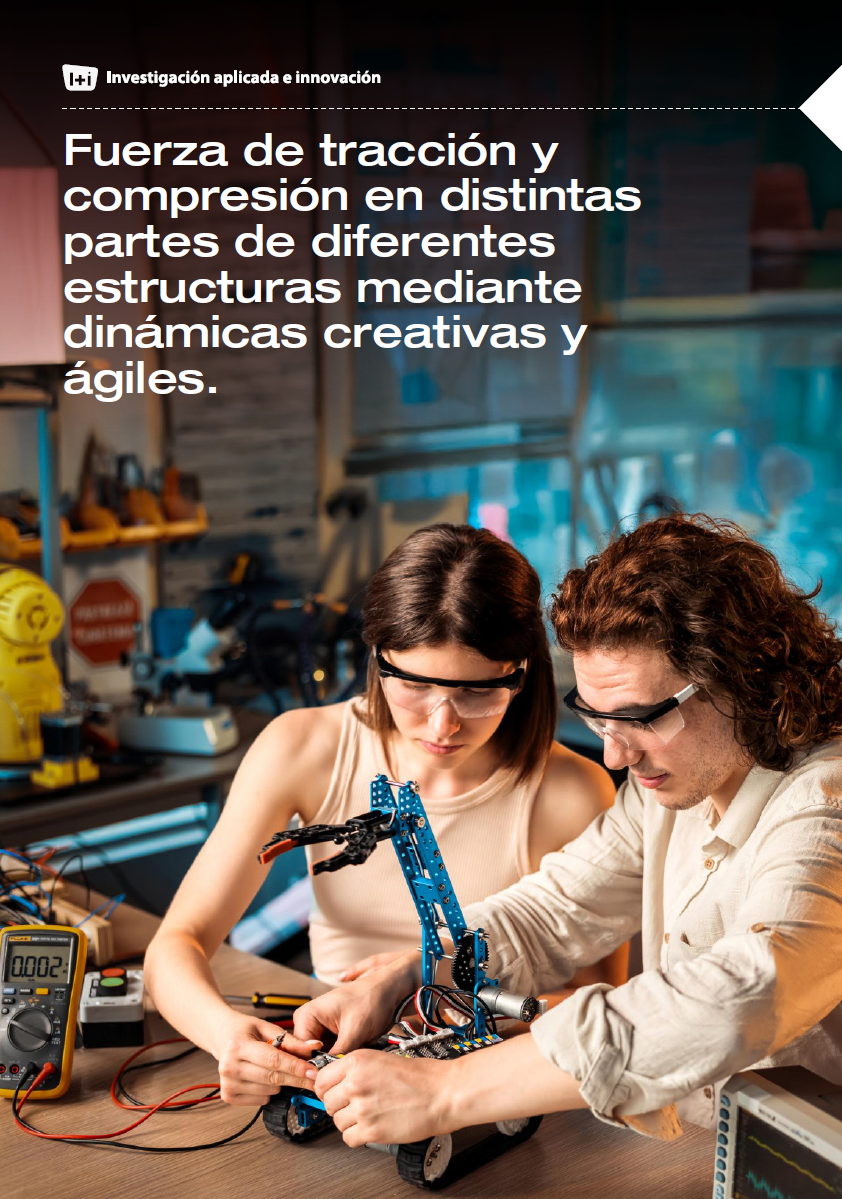
These types of structures can be programmed to generate motion, allowing for the analysis of various physical factors interacting with different parts of the structure. Tensile and compressive forces can be determined, depending on where the force cell is located. We work with PASCO Capstone software, which uses Bluetooth to capture real-time data captured by these sensors. Additionally, the PASCO software allows the servomotor to be programmed to generate motion in the assembled structure.
This type of study is innovative and applied to physics. Using creativity and agility, students can build different types of structures and then measure the tensile and compressive forces in different parts of the structure. It can also be programmed to generate movement in certain parts of the structure, according to the entered parameters.
The methodology used in the research has as its main focus the collection of information, in order to determine the percentage error of said value.
Our research concludes that by applying structured and innovative methodologies, students can also learn about physics-related topics by developing structures and measuring different values.
96.5% of students who developed the structures laboratory are satisfied with the methodology, and 29.8% of students rate the Structures Laboratory as interesting and creative.
After applying the Chi-square statistical test, it is concluded that there is no relationship between the degree programs studied by students and their level of satisfaction with structural assembly, which leads to the application of this new structural laboratory across all degree programs.
Downloads
References
[1] Bruun, J., & Christiansen, F. (2016). Kinaesthetic activities in physics instruction: Image-schematic justification and design based on didactic situations. Journal of Physics Education Research, 12(1).
[2] Casado del Prado, J., Carrascal Vaquero, I., Diego Cavia, S., & Arroyo Martínez, B. (2017). Sistema para el ensayo de cargas de fatiga de tracción y compresión sobre los elementos de sujeción de una vía ferroviaria dentro del mismo ciclo de carga.
[3] Cervera Ruiz, M., & Blanco Díaz, E. (2002). Mecánica de estructuras.
[4] Claussen, C., Forino, E., Kalinowski, N., Laverty, S., Mikolajko, R., Nguyen, A., ... & Stewart, J. (2020). Systems engineering capstone report.
[5] Hernández Barco, J. (2019). Implementación de una propuesta para la enseñanza del movimiento rectilíneo uniforme y uniformemente acelerado a partir de experiencias motrices como elemento didáctico innovador [Tesis de pregrado, Universidad Autónoma de Bucaramanga]. Repositorio UNAB.
[6] Hurtado Rincón, C., & Aguirre Chaparro, C. (2021). Diseño de un prototipo de una máquina tipo industrial para evaluación de fuerzas de tracción-compresión.
[7] Kuokkanen, J., Gutiérrez, D., Enkvist Snellman, J., & Romar, J.-E. (2023). Integrating movement and physical education into subject teaching. En Developing a didactic framework across and beyond school subjects (pp. 13–30). Routledge.
[8] Mentor, I., & Martin, C. (2016). Capstone project.
[9] Montoya Morado, E., & García Ramírez, M. (2024). Estrategia didáctica transversal para la enseñanza de la física general a través del deporte. RIDE: Revista Iberoamericana para la Investigación y el Desarrollo Educativo, 14(28).
[10] Sánchez Salcán, N., & Revelo, J. (2023). Estrategias didácticas basadas en una metodología activa para la enseñanza del movimiento unidimensional [Tesis de licenciatura, Universidad Nacional de Chimborazo]. Repositorio Digital UNACH.
Downloads
Published
Issue
Section
License
Copyright (c) 2025 Juan Peñaloza Calatayud (Autor/a)

This work is licensed under a Creative Commons Attribution-NonCommercial 4.0 International License.